

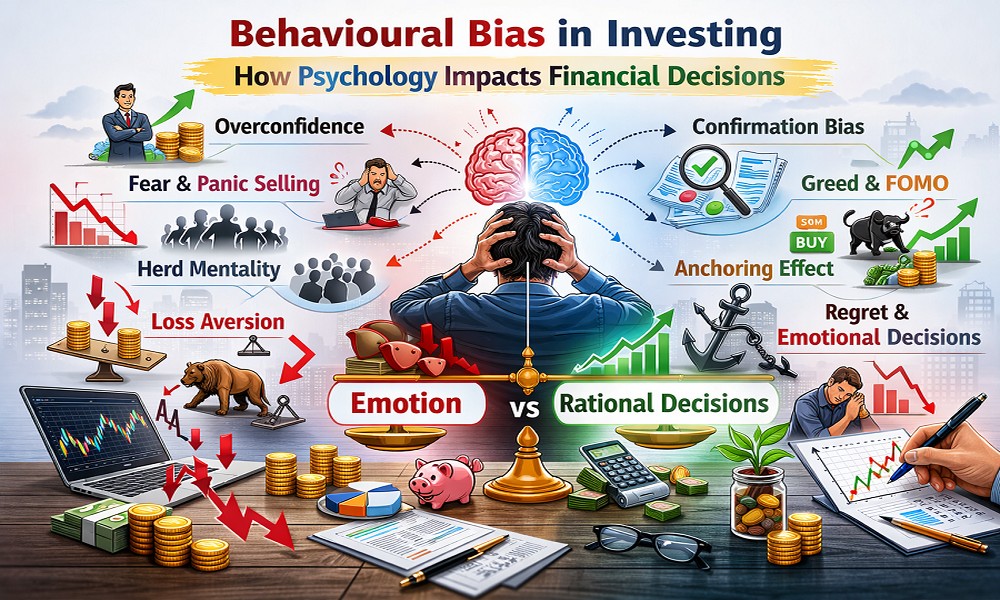
Investment performance is often discussed in terms of strategy, asset allocation and market timing, yet psychology plays an equally powerful role in shaping outcomes. Behavioural bias – the tendency for cognitive and emotional factors to influence financial decisions – can significantly affect portfolio returns. Even experienced investors are not immune to subconscious patterns of thinking that distort judgement. Market observers and professionals such as Kavan Choksi frequently highlight that mastering one’s behaviour can be just as important as analysing balance sheets or tracking economic indicators.
One of the most common behavioural biases is loss aversion. Research suggests that investors tend to feel the pain of losses more intensely than the satisfaction of equivalent gains. This can lead to overly cautious decisions after a market downturn, such as selling assets at depressed prices to avoid further discomfort. Ironically, this reaction often locks in losses and prevents participation in subsequent recoveries. A disciplined, long-term strategy can help counteract this impulse by encouraging investors to remain focused on broader objectives rather than short-term volatility.
Overconfidence is another widespread bias. During periods of strong performance, investors may attribute gains entirely to skill rather than favourable market conditions. This can result in excessive risk-taking, concentrated positions or increased leverage. When markets reverse, the consequences of overconfidence can be amplified. Regular portfolio reviews and diversification strategies can serve as safeguards against this tendency, ensuring that success does not lead to imprudent exposure.
Herd behaviour also influences financial markets. Investors often feel reassured when following popular trends, whether in booming equity sectors, emerging technologies or speculative assets. The fear of missing out can drive capital into overheated markets, inflating valuations beyond sustainable levels. Conversely, widespread panic can cause rapid sell-offs even when underlying fundamentals remain sound. Maintaining an independent investment framework grounded in research and long-term planning helps mitigate the impact of crowd psychology.
Anchoring bias presents a subtler challenge. Investors may fixate on a particular reference point, such as the price at which they purchased an asset. Decisions then revolve around that anchor rather than current market conditions or future prospects. For example, holding onto a declining investment solely because it has not returned to its original purchase price can hinder objective analysis. Evaluating assets based on forward-looking fundamentals rather than historical entry points encourages more rational decision-making.
Recency bias further distorts perception by causing investors to place disproportionate weight on recent events. After a period of strong returns, optimism may become excessive. Following a downturn, pessimism can dominate outlooks. Recognising this pattern allows investors to contextualise short-term developments within broader economic cycles.
Understanding behavioural bias does not eliminate emotion from investing, but it creates awareness. Structured investment plans, regular rebalancing and predefined risk parameters can reduce the influence of impulsive decisions. By acknowledging the psychological factors that shape judgement, investors can improve consistency, manage risk more effectively and enhance the probability of achieving long-term financial goals.
