

Introduction
Recruitment often feels like searching for pearls in an ocean. Thousands of resumes pour in, but only a few contain the spark an organisation truly needs. Traditional screening leaves hiring managers buried under repetitive tasks. Imagine instead a lighthouse guiding HR professionals directly to the most promising candidates. This is the promise of AI-based resume screening systems: transforming the tide of hiring from chaos to clarity.
The Orchestra of Data: A Metaphor for AI in Hiring
Think of data as an orchestra-every instrument representing a skill, qualification, or experience point. On its own, the music is overwhelming and chaotic. A conductor is needed to create harmony. In recruitment, AI acts as this conductor, orchestrating countless data points from resumes into a symphony of meaningful patterns. Rather than fumbling through noise, HR teams hear a clear melody pointing toward top talent.
This metaphor captures what many try to describe as “data science.” It is less about numbers on spreadsheets and more about crafting rhythm, balance, and flow from scattered fragments. Those trained through a Data Science Course understand how to tune the orchestra and ensure that the melody leads to better decisions.
How AI Reads Beyond Keywords
For years, resume scanning tools merely matched keywords: “Python,” “MBA,” “project management.” Yet this superficial approach overlooked context. An AI-driven system instead reads like a skilled interviewer. It distinguishes between a candidate who “attended a project management seminar” and one who “led multiple large-scale projects.”
By analysing language, chronology, and even the narrative arc of a career, AI avoids being misled by buzzwords. It looks for depth, coherence, and evidence of growth. This way, HR teams no longer need to gamble on surface-level impressions-they gain insights shaped by nuanced understanding.
Reducing Bias While Increasing Efficiency
Human bias has long haunted recruitment. Names, universities, or even formatting choices can unconsciously influence decisions. AI offers an opportunity to correct these blind spots by standardising evaluation. For instance, it can anonymise applications, focusing purely on skills and achievements.
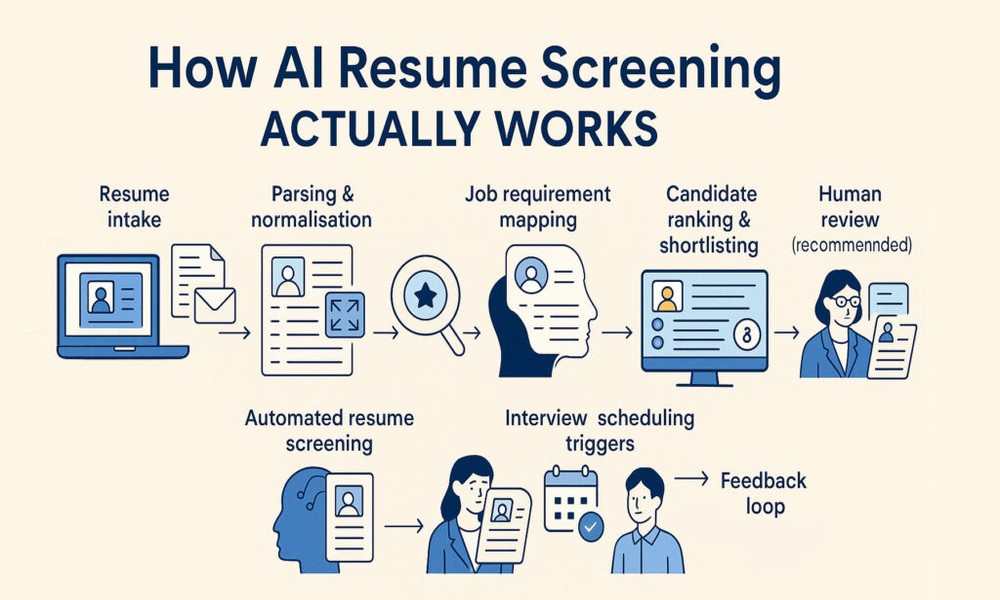
Additionally, efficiency skyrockets. A recruiter who once needed hours to scan 200 applications can now receive a ranked shortlist in minutes. Rather than replacing human judgment, AI removes the noise, allowing HR professionals to focus on meaningful conversations with candidates.
Those who undertake a Data Science Course in Bangalore often explore how algorithms can be trained not only for accuracy but also for fairness. This perspective is critical-AI in recruitment must be transparent, ethical, and continuously audited to ensure inclusivity.
Integration with the HR Ecosystem
An AI resume screening tool is not a standalone gadget. It becomes powerful when seamlessly integrated into the organisation’s HR ecosystem. Applicant tracking systems (ATS), onboarding platforms, and performance management software can all share insights with the AI engine.
For example, if high-performing employees often share certain patterns-like leadership in extracurricular activities or exposure to cross-cultural teams-the system learns to prioritise these traits in new applicants. This creates a virtuous cycle where data from successful hires feeds future recruitment.
Here, the orchestra metaphor resurfaces: AI as the conductor doesn’t just direct resumes, it aligns the entire HR symphony, from candidate sourcing to long-term employee success.
Challenges and Ethical Considerations
No transformation comes without caution. AI may inadvertently perpetuate existing inequalities if trained on biased datasets. For example, if historical hiring skewed towards a certain demographic, the AI could mimic these patterns.
This makes governance critical. Companies must treat their AI system as a living instrument that requires tuning and recalibration. Regular audits, transparent metrics, and human oversight ensure the technology remains a tool for progress rather than exclusion.
Moreover, candidates deserve clarity. Transparency about how AI is used in screening fosters trust, allowing applicants to feel they are evaluated fairly rather than filtered by a “black box.”
Conclusion
AI-based resume screening is not about replacing recruiters but about liberating them. Instead of drowning in paperwork, HR professionals can focus on the human side of hiring-conversations, culture fit, and career vision. The orchestra of data, once chaotic, becomes a symphony of insight.
For HR teams, the journey toward AI adoption is both technical and cultural. It demands openness to innovation and vigilance against bias. Yet the rewards are profound: faster, fairer, and more effective hiring.
As more professionals equip themselves with skills or even a specialised Data Science Course in Bangalore, organisations gain access to talent who can refine and guide these systems. In the end, AI in recruitment is about giving people-not machines-the stage to shine.
For more details visit us:
Name: ExcelR – Data Science, Generative AI, Artificial Intelligence Course in Bangalore
Address: Unit No. T-2 4th Floor, Raja Ikon Sy, No.89/1 Munnekolala, Village, Marathahalli – Sarjapur Outer Ring Rd, above Yes Bank, Marathahalli, Bengaluru, Karnataka 560037
Phone: 087929 28623
Email: enquiry@excelr.com
