

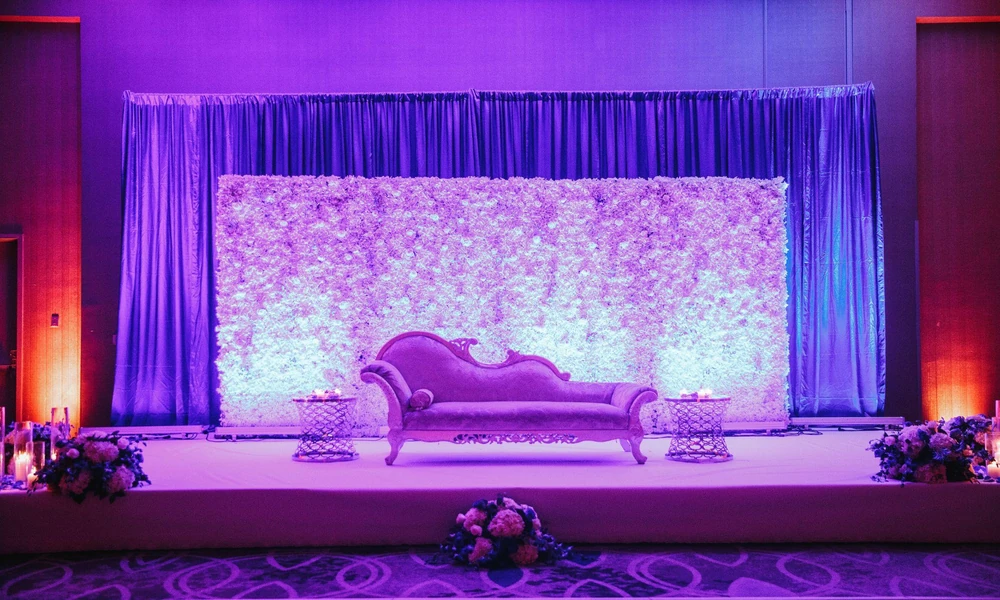
Gala backdrops are judged by one measure that nobody states in the brief: how the photographs look afterward. Guests take them on phones, in a dimly lit ballroom, from whatever angle they end up at, usually without pausing to consider lighting or composition, and that is the output the activation is actually producing. A printed panel and an illuminated neon piece perform quite differently under those conditions, and the difference is considerably larger than their appearance in a well-lit showroom or a daytime site visit suggests. Three trade-offs determine which suits a particular event backdrop in Singapore.
1. How Each Performs in the Low Light of a Gala Room
This is the decisive difference and the one most often underestimated at the planning stage, when the room is being viewed with the house lights up. Ballrooms during an evening programme are deliberately dim, with lighting focused on a stage or dance floor rather than on the perimeter where activations usually sit.
A printed backdrop depends entirely on being lit well by something else. Where the venue’s lighting is uneven, or the activation sits away from a usable wash, printed graphics photograph flat and dark on a phone camera, and guests end up with images that show a dim rectangle behind them. Supplementary lighting solves it and has to be specified, powered, and positioned, which is an additional line item that briefs frequently omit.
Illuminated signage produces its own light, which means it photographs consistently regardless of what the room is doing at any given moment. That reliability is the main reason neon signage in Singapore has become common at evening events, since it removes the dependency on venue lighting that nobody can fully control once a room is set, the programme is running, and the lighting desk is focused on the stage.
The caveat is that illuminated elements light themselves rather than the people standing in front of them, so a neon piece usually still needs supplementary lighting on the subjects if faces are meant to be visible rather than silhouetted.
2. Cost Structure, Lead Time, and What Happens to It Afterwards
Printed backdrops are inexpensive, quick to produce, and straightforward to change. A revised sponsor list, a corrected date, or a late addition to the lineup is a reprint rather than a redesign, and the panel is generally disposed of after the event with no expectation otherwise.
Neon fabrication costs considerably more and takes longer, with design, build, and testing all ahead of the date, which means decisions have to be locked earlier than many event teams are comfortable with. What it offers in return is reusability, since a well-made piece can be used across multiple events, displayed in an office or reception afterwards, or repurposed for a different activation, which changes the cost calculation substantially for an organisation running several events a year rather than one annual dinner.
Content flexibility is the trade-off. Anything event-specific, such as a year, a date, or a sponsor set, becomes fixed once fabricated, which is why reusable pieces tend to carry brand elements or a message rather than event details.
3. Installation Requirements and Venue Constraints
Printed panels need a frame, a footprint, and stability, and that is broadly the extent of what a venue will ask about.
Illuminated structures add power requirements, cable routing, electrical documentation, and heat considerations, and venues generally ask more questions about them during the approval process. The build takes longer, and the structure often needs testing on site before doors open. For events with tight access windows, or venues with limited power provision in the area where the activation sits, that complexity is a genuine constraint rather than an inconvenience to be worked around on the day.
Transport and handling also differ, since fabricated illuminated pieces are more fragile than a rolled printed panel and require proper storage and careful movement between uses, which matters if the intention is to reuse it across several events.
Combining Both Rather Than Choosing One
Many events resolve this by using each where it works best rather than picking a single approach. A printed step-and-repeat handles sponsor logos and event-specific information, which changes annually and needs to be legible rather than striking. An illuminated element provides the focal point guests actually choose to photograph themselves against.
That split tends to produce better results than either alone, because the two are doing genuinely different jobs: one communicates obligations to sponsors and partners, the other attracts guests to stand in front of it voluntarily. Deciding which role each element plays before briefing a fabricator usually produces a clearer design than asking for a backdrop and hoping a single structure achieves both at once.
Contact Sui Generis Neon to discuss your venue’s lighting and power conditions and which backdrop approach would photograph best.
